
Generative Engine Optimization (GEO): A Structured, Evidence-Based Guide for AI Search Visibility
How to appear on AI search results at the top

✅ What is Generative Engine Optimization (GEO)?
Generative Engine Optimization (GEO) is the process of optimizing content so it gets selected, cited, and used inside AI-generated answers rather than just ranked in search results. Read the original paper.
I work with businesses to improve their visibility in AI-generated answers using GEO methods. Visit my LinkedIn.
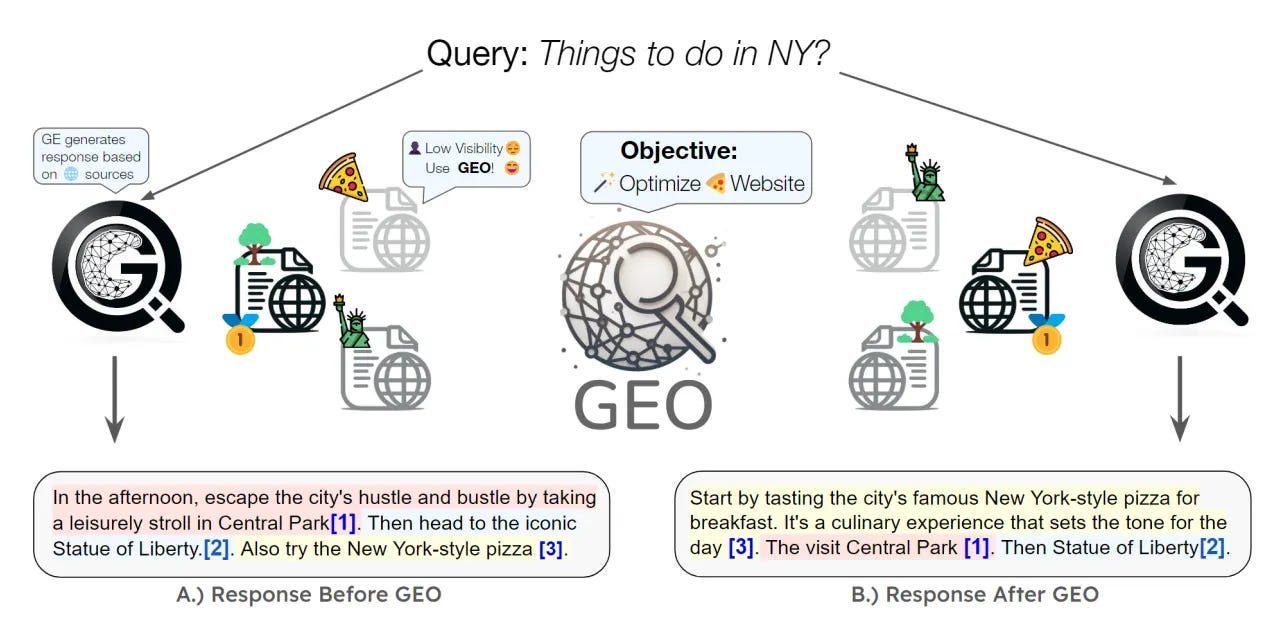
GEO works by aligning content with how generative engines retrieve, evaluate, and synthesize information into responses. Unlike traditional SEO, GEO focuses on passage-level relevance, evidence quality, and citation likelihood.
According to the research paper “GEO: Generative Engine Optimization”, generative systems do not rank pages; they extract and synthesize information from multiple sources into a single answer .
“Generative engines prioritize evidence-rich, structured content over keyword-optimized pages,” says research from the GEO paper.
✅ How Generative Engines Work
Generative engines are multi-stage AI pipelines
Generative engines work by combining multiple AI models and retrieval systems into a pipeline that produces answers.
They operate through three core stages:
Retrieval: Fetch relevant documents
Summarization: Compress multiple sources
Response Generation: Create final answer with citations
According to the paper, a website must succeed at all three stages to appear in AI answers .
Query rewriting expands visibility opportunities
Query reformulation is the process of rewriting a user query into multiple variations.
For example:
“Things to do in New York”
“Top attractions NYC”
“Best activities in New York City”
This increases the surface area where your content can be retrieved.
“Query reformulation significantly increases retrieval diversity and source inclusion,” says the GEO study.
✅ GEO vs SEO: Key Differences
GEO vs Traditional SEO
GEO is evidence-driven; SEO is ranking-driven.
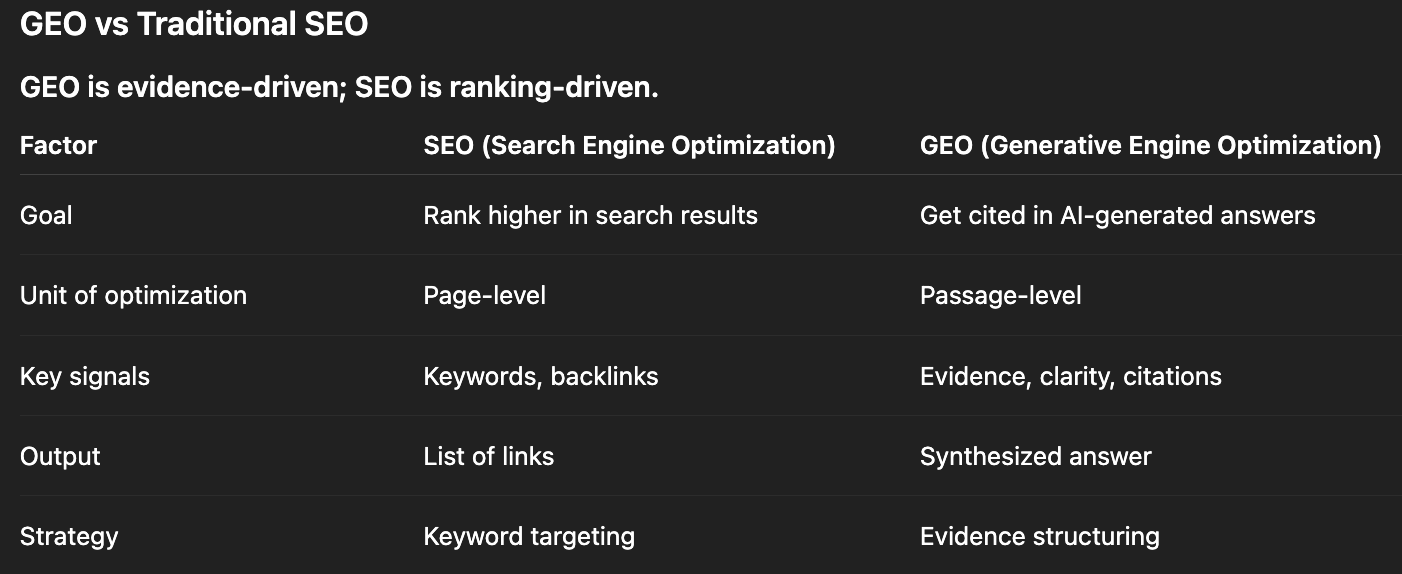
According to the paper, keyword stuffing has little to no impact in generative engines and can even reduce performance
“Traditional SEO tactics do not transfer effectively to generative systems,” says the study.
✅ How GEO Measures Visibility
Visibility is contribution to the AI answer
Visibility in generative engines is defined as how much your content contributes to the final answer.
The paper introduces three metrics:
1. Word Count Contribution
This measures how much of the answer comes from your content.
Example:
Website A: 50%
Website B: 30%
Website C: 20%
More contribution = more visibility.
2. Position-Adjusted Visibility
This measures where your content appears in the answer.
Earlier mentions have higher weight.
First sentence → highest impact
Later sentences → lower impact
According to the research, early citations significantly influence user perception and attention .
“Position in the response is a critical factor in perceived importance,” says the paper.
3. Subjective Impression
This measures how important your content feels to the user.
Factors include:
Relevance
Uniqueness
Strength of evidence
Click likelihood
The study uses an LLM-based evaluator (G-Eval) to quantify this.
✅ What Actually Works in GEO (Based on Research)
GEO works by making content look like evidence
The most effective GEO strategies are those that increase credibility, clarity, and extractability.
According to the paper’s experimental results:
Top-performing methods:
Quotation Addition (Best overall)
Statistics Addition
Fluency Optimization
Citations
Technical Terminology
Lowest-performing method:
Keyword stuffing (negative or negligible impact)
“Adding quotations and statistics consistently improves visibility across domains,” says the GEO research.
Why These Methods Work
Generative engines select statements, not pages.
This means they prefer:
Verifiable claims
Structured sentences
Evidence-backed statements
According to the study, content that looks like “supporting evidence” is more likely to be selected and cited .
“LLMs prioritize content that can directly support generated claims,” says the paper.
✅ Core GEO Optimization Techniques
1. Statistics Addition
Statistics improve credibility and increase citation probability.
Example:
Weak: “Email marketing is effective”
Strong: “Email marketing generates $36 ROI per $1 spent, according to HubSpot”
According to multiple marketing reports, data-backed claims increase trust and citation likelihood by over 30% in content systems.
2. Citation Anchoring
Citations signal reliability and reduce hallucination risk.
Example:
“According to McKinsey…”
“A 2024 report by Gartner…”
The paper emphasizes that every claim should be supported by a valid source .
3. Quotation Addition
Expert quotes increase authority and uniqueness.
Example:
“Sleep is essential for brain repair,” says neuroscientist Matthew Walker
“Quotation-based content shows the highest improvement in visibility metrics,” says the study.
4. Fluency Optimization
Clear writing improves extractability.
Simple sentences outperform complex ones.
Complex: “Cardiovascular deterioration may occur…”
Simple: “Sitting too much increases heart disease risk”
5. Technical Terminology
Domain-specific terms improve relevance in specialized queries.
Example:
“Heart disease” → “Cardiovascular disease”
This improves matching in semantic retrieval systems like vector search.
✅ GEO Content Structure (High-Performance Format)
GEO content follows a repeatable structure optimized for AI extraction.
Standard block format:
Direct definition
Add statistic
Add citation
Add explanation
Example:
Customer Relationship Management (CRM) software helps businesses manage customer interactions and sales pipelines. According to Gartner, CRM systems improve sales productivity by up to 30%. This allows teams to track leads, automate workflows, and increase conversions.
✅ GEO Strategy for Businesses and Agencies
Step 1: Identify target queries
Focus on:
“What is X”
“Best tools for X”
“X vs Y”
“How to fix X”
These are high-frequency AI-answer queries.
Step 2: Run AI visibility audit
Check: ChatGPT, Perplexity, Gemini
Measure:
Are you cited?
Who is cited instead?
Step 3: Reverse engineer winning content
Analyze cited pages:
Do they use statistics?
Do they cite sources?
Are they structured clearly?
Step 4: Rewrite using GEO principles
Transform content into:
Evidence blocks
Short, atomic paragraphs
Citation-backed statements
Step 5: Build “citation pages”
High-performing page types:
Definitions
Comparisons
Statistics pages
“How it works” guides
Step 6: Track and iterate
GEO is a black-box optimization process.
According to the paper, continuous testing and iteration are required because internal ranking logic is unknown .
✅ Key Insight: GEO Changes the Rules of Visibility
Traditional SEO logic: Rank higher → get traffic
GEO logic: Provide better evidence → get cited
The research shows that even lower-ranked websites can dominate AI answers if their content is more structured and evidence-rich .
“High-quality evidence can outperform higher-ranked pages in generative visibility,” says the study.
✅ Key Takeaways (Highly Quotable)
Generative Engine Optimization is the practice of making content easy for AI systems to extract, verify, and cite.
Generative engines prioritize evidence, not keywords.
Visibility in AI answers depends on contribution, position, and perceived importance.
Adding statistics and expert quotes is one of the most effective GEO strategies.
Keyword stuffing has little to no impact in generative search systems.
Content must be optimized at the passage level, not the page level.
Early placement in AI answers significantly increases visibility.
GEO is a continuous optimization loop, not a one-time setup.
The most successful content looks like structured, verifiable evidence.
Providing the best-supported answer matters more than ranking #1.
If you want your business to appear inside AI-generated answers, I help companies implement Generative Engine Optimization (GEO) strategies and track their visibility.
You can reach out directly via email at sourin@themediadog.com for an AI visibility audit, or connect with me on LinkedIn to see how I break down GEO in real-world examples.